Glute Exercises at Home: The 5 Best for Growth
Why the burn doesn't equal glute growth
Your glutes aren't just about how your figure looks — they're among the strongest muscles in your body. When they're well developed, your posture improves and you get stronger in other exercises too.
You may have seen studies or videos where EMG shows that 90 or even 100% of glute fibers fire in a certain exercise, so it must be the most effective one. But high muscle activation in an exercise doesn't equal growth. There are functional exercises where the glutes fire very strongly, but you won't build your glutes with them.
Strength training for your glutes has to meet three growth criteria: progressive overload, nutrition and recovery. Many functional movements fail the first one — you simply can't increase the load. As a result, the muscle works, but doesn't grow.
So the best glute exercises meet two conditions:
- The glutes perform their main function — flexing and extending the hip joint.
- You can keep progressing in them.
Glute exercises at home: the 5 best
All five exercises can be done both at the gym and at home. At home, dumbbells replace the barbell and machines.
1. Deadlift or Romanian deadlift
At the gym it's convenient to do in a Smith machine; at home — with dumbbells. You can progress in two ways: increase the weight or do a single-leg deadlift. On one leg, the load on each glute becomes much higher at the same weight — handy if your dumbbells at home are limited in weight.
2. Glute bridge
A very effective exercise, because the work comes directly from flexing and extending the hip joint. At home, dumbbells replace the barbell, and you can progress for a very long time: first the bridge with your shoulders on a bench, then add a step under your feet, and the next level for advanced lifters is the single-leg bridge. I cover the form in detail in my article on the glute bridge.
Pay special attention to form: your torso moves as one line, as if you'd swallowed a stick — head, neck and torso together. There should be no arch in your lower back.
3. Sumo squat
In this squat variation, the focus is on the gluteus maximus and less on the quads.
4. Deadlift lunge
It's similar to a single-leg deadlift, but your knee bends more during the movement. When you slightly bend your knee at the bottom, the glute stretches more and the load on it increases. This small detail noticeably boosts the exercise's effectiveness — add this tip to your program.
5. Kickbacks
At the gym, this is the cable kickback — pure isolation for the gluteus maximus, with minimal quad work and almost no load on the knees. At home there's no cable machine, and a great substitute is the all-fours kickback (donkey kick). You can add weight with an ankle weight, but I recommend a dumbbell: it makes it easier to increase the load gradually. If you place the weight behind your knee rather than at your ankle, you can use more weight and progress better.
Choosing your focus: sumo, plié and quads
Don't confuse the sumo squat with the plié squat. In a plié your feet are even wider, and the focus shifts to the inner thighs and the gluteus medius. A gluteus medius focus doesn't suit everyone: a lot depends on how your muscles attach and the shape of your glutes. If you want to load the gluteus maximus specifically and the quads less, choose the sumo squat.
But keep in mind: while you're building mass with compound exercises, your quads respond well too. Many women find this off-putting, but it's an unavoidable downside. Don't be afraid to go through this stage. Once you've built mass and learned to feel your glutes working in every exercise, it becomes easier to keep growing them.
Can you grow your glutes at home without weights?
Growing your glutes at home without extra weight, just by adding sets and reps, is practically impossible — or rather, not very effective if this muscle group isn't naturally responsive. The thing is, besides muscle fatigue there's also central nervous system fatigue. During your 100 squats, it will set in much sooner than the muscle runs out of energy.
This approach suits beginners or people who are gradually getting back into training. To grow your glutes, you need extra weight.
How I do it
Those who've followed me for a long time know that I used to be skinny fat, and my glute program didn't work. Only banded kickbacks, no heavy weights — I was afraid of getting bulky. My glutes are naturally flat, and those exercises gave me no volume at all.

When I started my path as a fitness trainer and went to study, I changed my program and started training for mass. 80% of the program was compound exercises: squats, mostly sumo, stationary lunges, deadlifts and dumbbell kickbacks. The program got heavier, and in my case a noticeable result appeared after 3 months, and after 6 — quite rounded glutes.
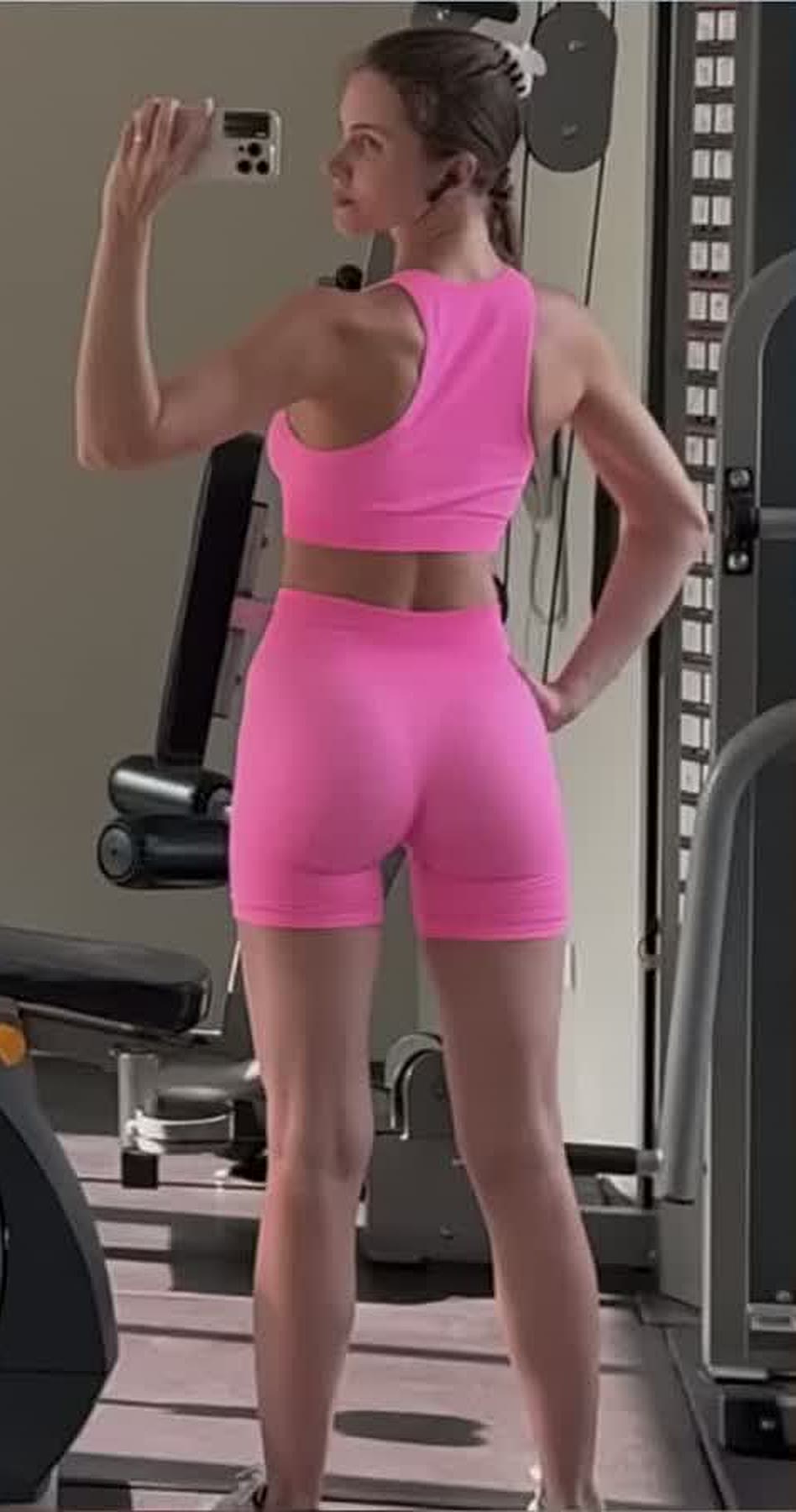
Now I do compound exercises — deadlifts, lunges, squats — with moderate weight for more reps: 2–3 sets of 20. And isolation exercises for the gluteus maximus with enough weight, 3 sets of 10–15 reps: the glute bridge for 15 reps with a barbell of about 40–42 kg (roughly 88–93 lb), kickbacks about 3 × 12–15 per leg, the deadlift lunge or deadlift — 3 × 12–15.
I train my lower body with a glute focus twice a week, doing two, at most three exercises per workout: a compound one (squats or lunges), glute isolation and hamstring isolation — or quads separately.
Common mistakes
- Choosing an exercise by the highest activation. If you can't increase the load in an exercise, the muscle works but doesn't grow.
- Training only with a band out of fear of "getting bulky". I did that myself — it gave me no volume.
- Confusing the sumo squat with the plié. In a plié, the focus shifts to the inner thighs and the gluteus medius.
- Dropping compound exercises because your quads respond. It's an unavoidable stage of building mass.
- Trying to grow your glutes with hundreds of reps and no weight. Your nervous system will tire out before the muscle does.
FAQ
How many times a week should I train my glutes?
I train my lower body with a glute focus twice a week and do two, at most three exercises per workout. Muscles need recovery to grow.
How many sets and reps should I do for glutes with dumbbells?
I do isolation exercises with enough weight — 3 sets of 10–15 reps, and compound exercises with moderate weight for 2–3 sets of 20. Progress by increasing your dumbbell weight or switching to a single-leg version.
Why do my legs grow instead of my glutes?
While you're building mass, your quads also work hard in compound exercises — that's unavoidable. To shift the load to your glutes, choose the sumo squat over the plié and add isolation: kickbacks and the bridge.
What's the most effective exercise for glutes?
Not the one with the highest muscle activation, but one where your glutes extend the hip joint and where you can gradually increase the load. For example, deadlifts, the glute bridge, sumo squats, the deadlift lunge and weighted kickbacks.
